We are excited to announce the release of CyberRangeCZ v2026.02, marking a significant step forward for our cyber range platform. This release delivers a substantial update, including a redesigned frontend portal, a new Guacamole backend service, support for air-gapped deployments, dependency upgrades, and multiple stability and security fixes.
Frontend Portal
The frontend of CyberRangeCZ has received a major improvement, delivering a faster, more reliable, and visually enhanced user experience. Key features include a loading screen, extended caching, collapsible split view in training levels, and a modernized training progress visualization.
The sandbox allocation screen was fully redesigned. Allocation stages are now presented in a carousel layout. Log views have been fixed
and improved to follow the output automatically. The log console now supports searching, line wrapping and fullscreen view. Lastly, the color scheme was adjusted for better readability.
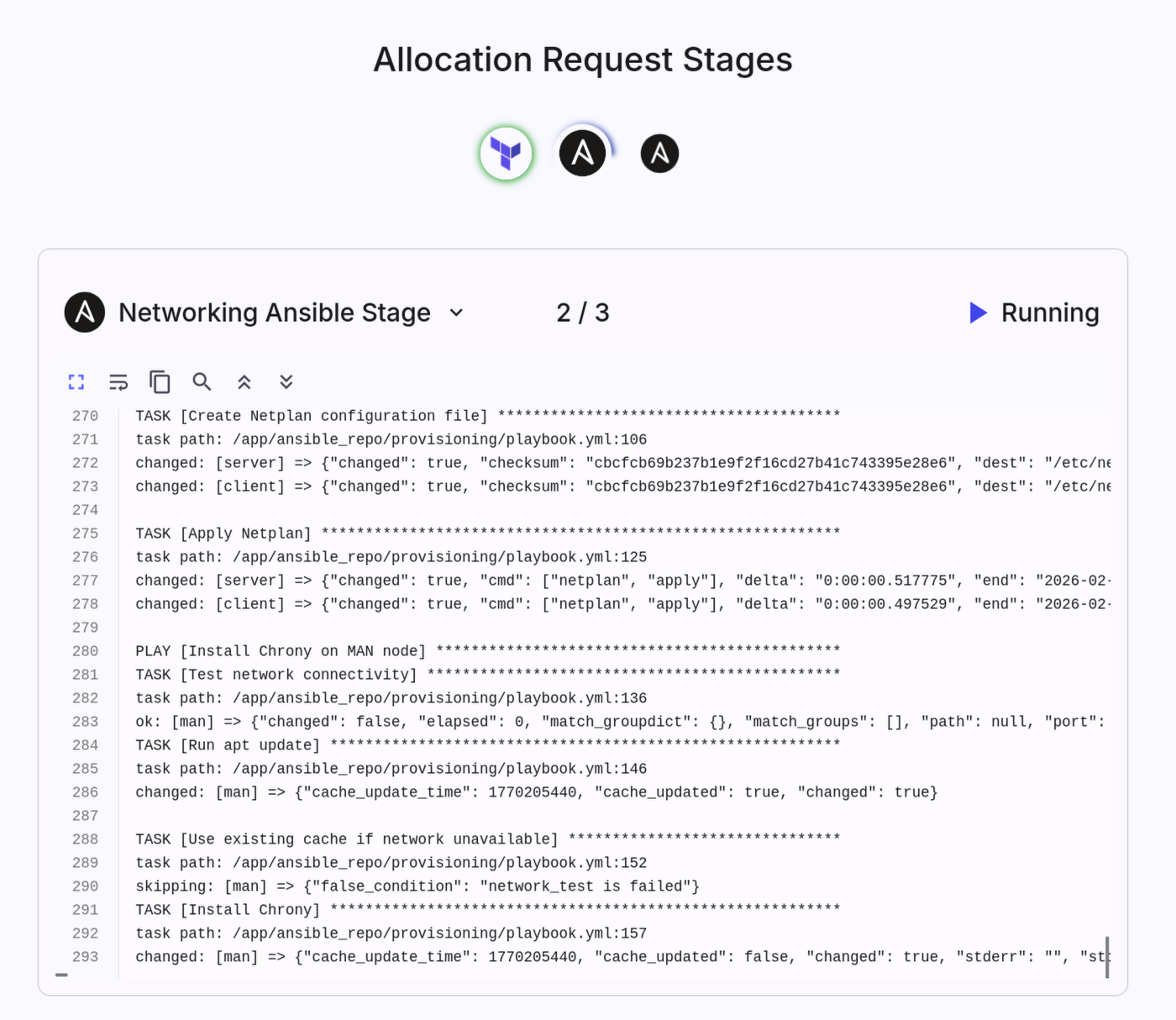
Allocation request stages.
New allocation request stages.
The most significant changes were made to topology visualization.
It has been optimized to smoothly handle large topologies with many nodes (hosts, routers) and to automatically distribute them evenly without overlaps. All elements are draggable and self-organize using physics-based real-time simulation. New icons were added, including operating system indicators and console markers. SSH consoles are now accessible via double-click without using the context menu.
By default, Guacamole consoles open in an embedded tab, allowing users to read assignments and interact with the infrastructure simultaneously.
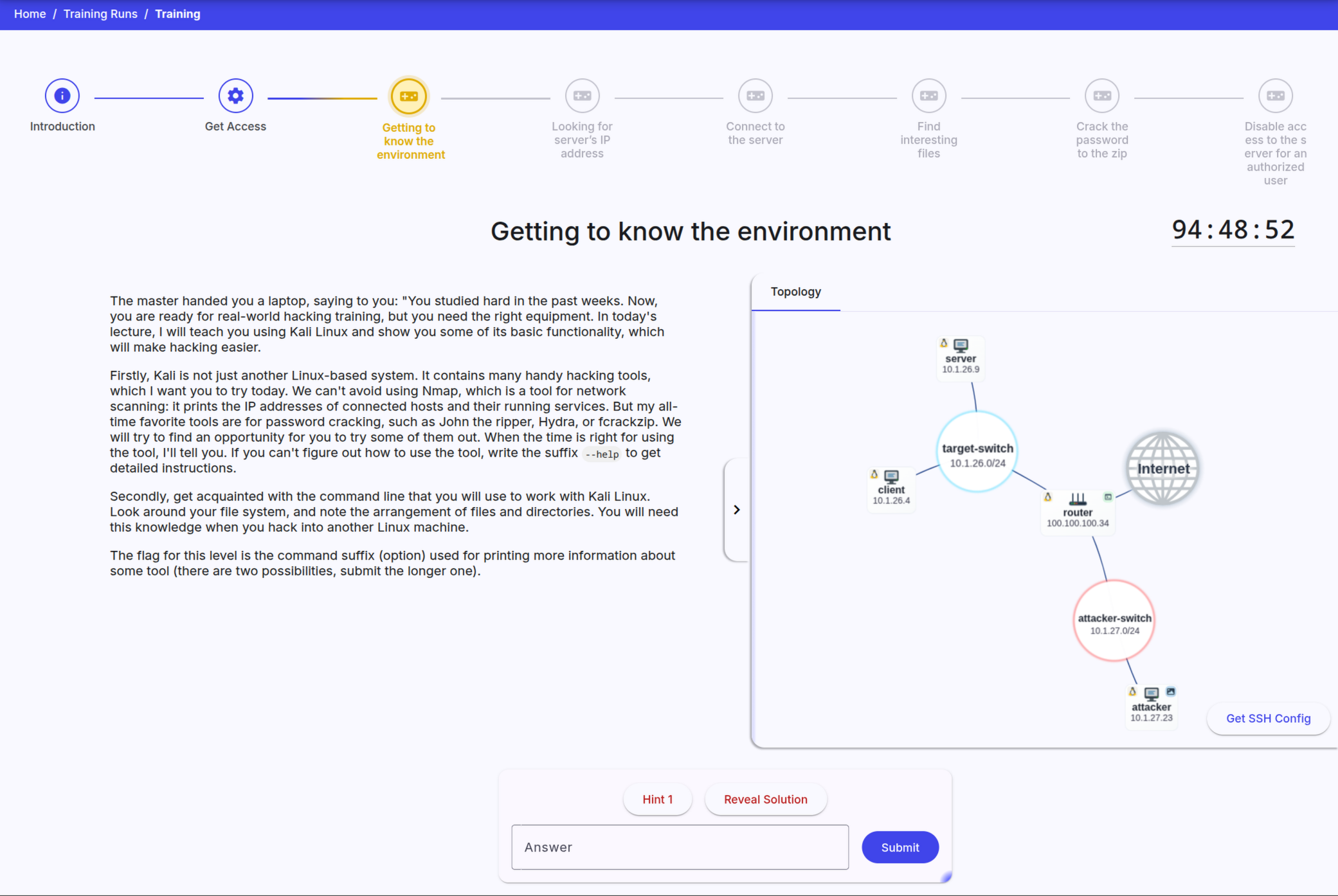
Redesigned training levels. New topology visualization.
Redesigned training levels. New topology visualization.
The dashboard and pools interfaces have been improved to provide
a smoother, more informative overview of trainee activity.
The dashboard now features a reworked progress visualization
with better responsiveness, verbose hover tooltips, zoom/drag controls, trainee pinning, and filtering by level and lag behind estimate.
The pool and sandbox tables now clearly indicate lock states, available actions, and resource usage.
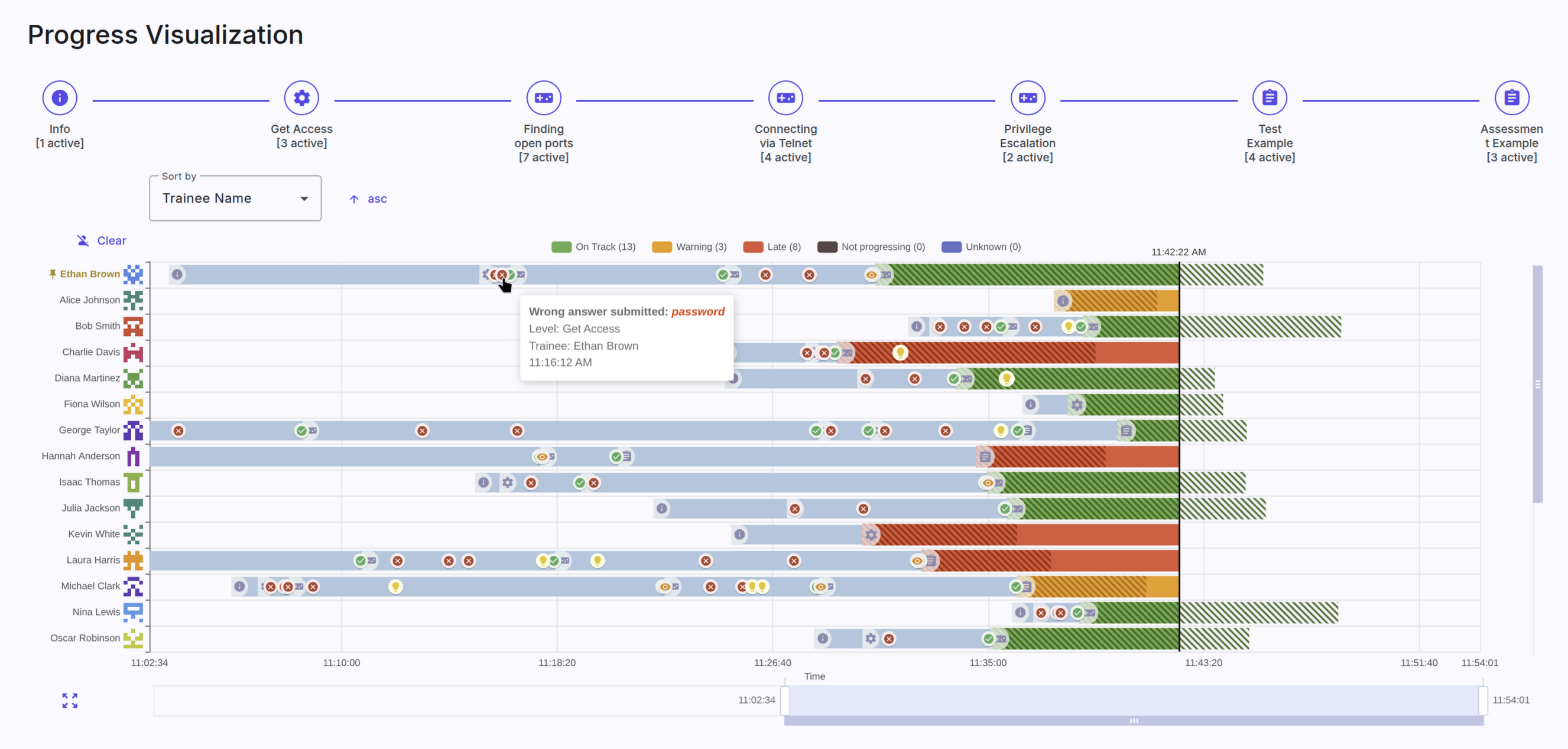
Fully redesigned progress visualization bar.
Fully redesigned progress visualization bar.
As part of our modernization efforts, the frontend has been migrated
to an Nx monorepo, deprecating the older polyrepo structure,
and updated to Angular 20 with standalone components. This migration improves maintainability and development workflow.
The codebase is currently significantly more accessible to new contributors since the frontend is now a single solution, buildable
with a single command.
Guacamole service
A new Guacamole microservice replaces the previous third-party Guacamole API integration. Console management is now fully integrated into the CyberRangeCZ Platform REST API, enabling OIDC-based authentication instead of using native Guacamole credentials.
This change also resolves an issue where opening multiple consoles
for the same VM could break the session, previously requiring
a VM restart.
Sandbox service
The sandbox service now supports deployment behind a load balancer, with configurable SSH ProxyJump port and a central syslog port. A new windows_hosts Ansible group was introduced to allow direct targeting
of Windows hosts during provisioning, even when Ansible facts are not yet available.
The codebase was updated to Python 3.12.
Ansible and Terraform outputs have been reworked for improved performance and usability. Pagination has been removed, logs are now returned as preprocessed strings, and incremental fetching is supported via the from_row parameter. GZIP compression has been added, enabling approximately 12× faster loading of large logs, making sandbox provisioning faster, more flexible, and easier to monitor.
Ansible stage one
MTU detection is now automatic, replacing the previous static value
of 1442. Netplan is now used for all modern Debian and Ubuntu hosts, unifying network configuration and resolving routing issues across multiple OpenStack providers.
Deployment tools
The original PostgreSQL Helm chart has been replaced with PostgreSQL 17 deployed via a Kubernetes operator. Helm hook scripts were improved with enhanced logging and more robust error handling.